The Current Reality Facing District Workforce Strategy
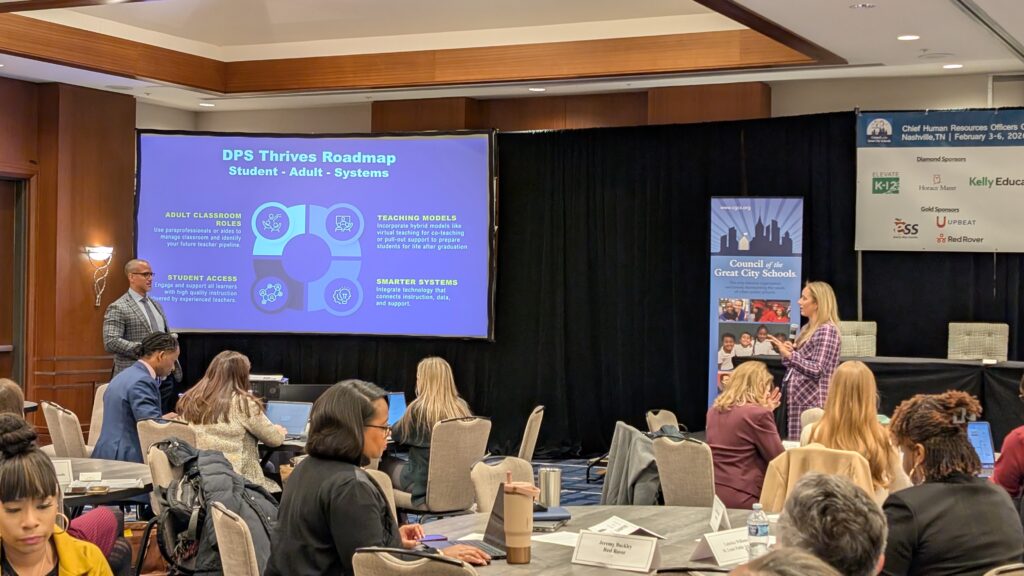
Every conference has a theme, whether it is written on the agenda or not. For me, the Council of Great City Schools Chief Human Resources Officers Conference made one thing unmistakably clear: districts are done waiting for the system to fix itself.
I spent the week listening to HR leaders who are tired of reacting and increasingly focused on redesigning how their districts actually work. Not in abstract terms, and not in five-year plans that never quite materialize, but in concrete decisions about staffing, support, technology, and accountability that show up in classrooms right now.
What stood out most was not a single solution or tool, but a shift in posture. The districts making real progress are no longer framing vacancies, retention, or AI adoption as forces happening to them. Instead, they are approaching these challenges as interconnected parts of a broader district workforce strategy they can actively shape.
That mindset showed up again and again in conversations about workforce planning, teacher support, early talent pipelines, and the role technology should play inside HR teams. The leaders who left the strongest impression were not chasing novelty or silver bullets. They were focused on building systems that make teaching sustainable and student outcomes nonnegotiable.
These are the four takeaways from CGCS that stayed with me long after the sessions ended.
Four Takeaways from CGCS that Capture the State of District Workforce Strategy
What follows reflects the conversations that felt most grounded in reality. Not theory, not trends for trend’s sake, but the choices districts are actively making to stabilize their district workforce strategy and protect instructional quality.
1. Vacancies aren’t inevitable. They’re designed.
One of the most consistent throughlines I heard at CGCS was a quiet but powerful reframing of vacancies. The districts making real progress are no longer treating unfilled roles as an unavoidable outcome of the labor market. Instead, they are looking inward at timing, systems, and accountability, and asking where breakdowns occur before they show up on a vacancy report.
In these districts, staffing does not begin in late spring or after resignations occur. Forecasting begins months earlier. Processes are tighter. Roles and expectations are clearer across HR, central office, and school leaders. Principals are not operating in isolation, and HR teams are not left to clean up issues after the fact. Ownership is shared, and near-zero vacancies are treated as the standard, not an aspirational stretch goal.
That does not mean the work is easy or that constraints disappear. But the mindset shift matters. When districts stop framing vacancies as something that simply happens to them, they create room to redesign how hiring timelines, approval processes, and school-level accountability actually function. Control is not absolute, but it is far more possible than many systems have been led to believe, especially when vacancies are addressed as a core component of district workforce strategy rather than a seasonal problem.
2. AI adoption fails when it’s treated as a tech initiative.
Some of the most compelling conversations at CGCS were not about specific AI tools at all. They were about frustration. HR leaders shared that momentum stalls quickly when AI is introduced as a standalone technology rollout rather than as a way to solve real, time-consuming problems.
What resonated most was a clear distinction between training and usefulness. Districts are discovering that adoption does not hinge on how many staff attend an AI workshop. It hinges on whether the technology actually helps teams move faster, reduce errors, or eliminate low-value work in day-to-day HR processes. When AI is framed around outcomes, not features, resistance drops and trust builds.
Just as important was the emphasis on guardrails. HR leaders were candid about concerns related to risk, privacy, and accuracy, especially in systems that touch employee data, compliance, or student services. The districts making progress are not pushing AI everywhere. They are being selective, setting clear boundaries, and aligning use cases to workflows where confidence and oversight matter most.
The takeaway was simple but telling: adoption follows usefulness, not novelty. When AI is positioned as infrastructure that supports people rather than replaces judgment, it becomes far easier to integrate in ways that stick.
3. Teacher retention is about conditions, not commitment.
Retention came up in nearly every conversation, but not in the way it often does. HR leaders were clear that the issue is not a lack of passion or dedication among teachers. Most educators are entering the profession deeply committed to students and communities. What is failing them is the conditions under which they are asked to work.
Districts seeing real gains in retention are not lowering expectations or redefining rigor. Instead, they are redesigning the systems that surround teaching. That includes modernizing coaching and professional learning, reducing administrative drag, and being far more intentional about how instructional time is protected. When teachers are given space to focus on teaching rather than constantly managing overload, stability improves.
This aligns closely with what we have heard directly from teachers. In our recent survey of over 1,000 educators, the strongest signals were not about compensation or commitment, but about feeling supported, having time to teach, and experiencing flexibility in how they work. When those conditions are present, teachers stay. When they are not, even the most dedicated educators burn out.
What stood out most was how pragmatic these conversations were. Retention was not framed as a morale initiative or a culture campaign. It was discussed as an operational challenge that requires structural solutions. When working conditions improve, teachers stay. Commitment alone does not sustain a workforce.
4. The talent pipeline is shifting earlier and getting more intentional.
Another clear shift at CGCS was how early districts are thinking about the talent pipeline. Rather than focusing solely on recruitment once vacancies appear, more HR leaders are investing upstream in models designed to keep early-career educators in the profession from the start.
Apprenticeships, grow-your-own pathways, and co-teaching models came up repeatedly, especially as districts look for ways to support novice teachers without overwhelming them. The common goal across these approaches is to reduce isolation, pair new educators with experienced teachers, and make the first years of teaching feel manageable rather than punishing.
What connected these strategies was a recognition that retention does not begin in year three or five. It begins in the first classroom experience. When districts design early-career pathways with support, mentorship, and shared responsibility built in, fewer teachers reach the point of burnout in the first place. Retention starts before burnout sets in.
What This Signals for Districts Moving Forward
Taken together, these conversations point to a meaningful shift in how district HR leaders approach their work. District workforce strategy is no longer about isolated fixes but about designing systems that support stability, adaptability, and instructional quality simultaneously.
The districts making headway are not treating staffing, retention, or AI as isolated initiatives. They view them as interconnected parts of a larger system that either support or undermine instruction. That systems-level thinking is what allows them to move from constant reaction to sustained stability.
What struck me most at CGCS was the clarity of purpose. Students were not an abstract end goal. They were the non-negotiable center of every decision, from how early pipelines are built to how technology is introduced to how teachers are supported day-to-day.
That clarity does not eliminate complexity. But it does create momentum. And right now, momentum matters.

About the Author
Kim Kays is a seasoned education leader with 20+ years of experience across K-12, non-profits, and edtech. As VP of Partnership Solutions & Strategy, she develops instructional solutions and equips sales teams to align them with district needs. A former principal in Chicago and Oakland, Kim drove transformative gains in biliteracy and student achievement, and founded a non-profit delivering arts education to thousands. She’s held national advisory roles with Nearpod and Renaissance, and is recognized as a thought leader focused on elevating instruction and closing opportunity gaps. Kim currently serves as Elevate’s VP of Partnership Solutions & Strategy, leveraging her experience and expertise to ensure districts across the country are able to meet their students needs.